

.jpg)
Luxor Temple of Egypt
- Where is the Luxor Temple Located
- Who Built & discovered the Luxor Temple
- what was it used for
Egypt is a Land filled with Mystery, Great food, Warm local hospitality, Captivating cities and Relics of the Great Civilisation of the Ancient Egyptians. Few, however, are able to compete with the Beauty of the Picturesque Luxor in Egypt and its Many Historical sites Such as The Temple of Karnak & last but not least, the Luxor Temple. Despite the many things to see & to do in Luxor the Luxor temple stays prominent among all. As with Any Relics from the Egyptian Pharaonic Era is subject to a multitude of questions like Who built the Luxor Temple & who Discovered it amongst others. Today we will attempt to give you the answers you need giving you one more Reason to Visit the Beautiful city of Luxor in Egypt.
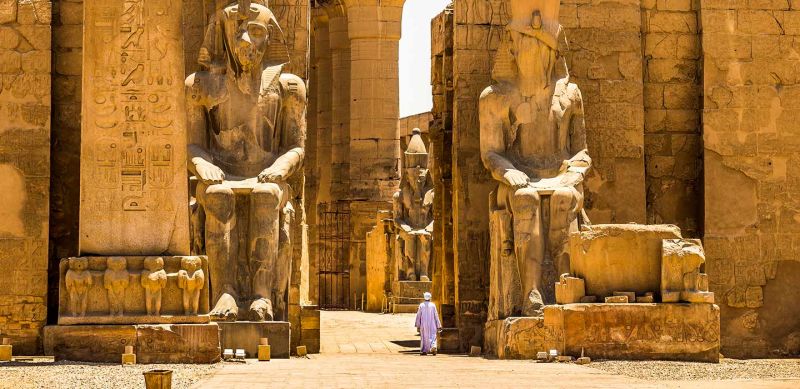
Where is the Luxor Temple located?
This Complex of a Temple is located in the City of Loxur in Egypt on the East bank of the River Nile & A one hour from Cairo by air, 3 hours by road from Hurghada, and three hours by road from Aswan. Known as “ipet resyt” in the Era of the Ancient Egyptians Translating to “The Southern Sanctuary” and is one of the Many Temples and ancient constructs that riddle the East & West Bank of the Nile. Despite the aforementioned fact, the Luxor Temple Stands out among its brethren as it is not dedicated to a certain god or cult but the constant Renewal of Kingship.
Tailor-Make your Journey to Luxor with Memphis tours
Who Built & discovered the Luxor Temple?
Its believed that that this monumental temple was built around 1400 BCE WIth the Credit of Construction shared between Amenhotep the third of the 18th dynasty, Tutankhamun & Ramses the Second. Built using sandstone from the Gebel el-Silsila Area located in the South-Western Area of Egypt commonly referred to as Nubian Sandstone. The Luxor Temple sticks to the same themes of symbolism & illusionism. An example of such a technique is the two Obelisks flanking the entrance are not Equal in height yet Create the illusion that they are. The massive temple complex is 850 feet long and about 213 feet across the front. The main entrance leads to a vast peristyle courtyard built by Ramses the second and serving as a chapel in Roman times.
The first unofficial discovery could be attributed to the local inhabitants of the are lived in and around the temple. Yet the FIrst true excavation of the Luxor Temple started in 1884 by Gaston Maspero after getting the green light to commence operations. The excavations carried own periodically until 1960. Lately, Maspero has received the authorisation needed for fund-collecting to negotiate compensations for the locally inhabited pieces of Land
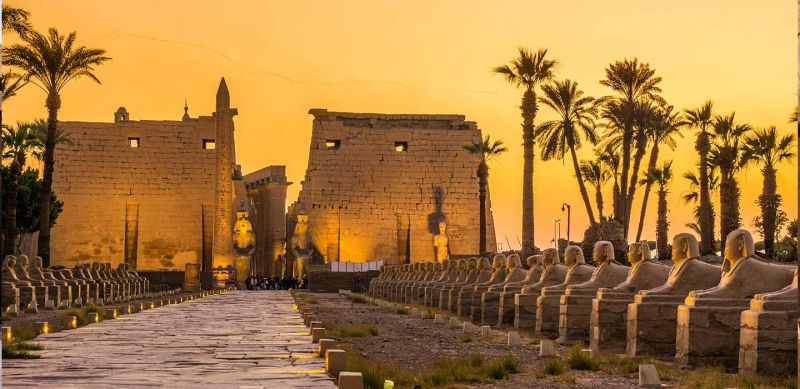
What was the Temple used for?
The Luxor Temple as mentioned above held no devotion to a specific pharaoh or Ancient Egyptian deity. It was However dedicated to the Theban Triad of the cult of the Royal Ka. The temple also acted as a centrefold of the Opet Festival in wich a statue of Amun was paraded through the Nile from near the Karnak Temple. Another Important Section of the Temple was the Shrine stations. A straight line Avenue between the Luxor & Karnak Temple with human-headed sphinxes of Nekhtanebo. Each of the Stations had its own importance such as the station of Kamare that cooled the oar of Amun, Last but not least the temple is believed to have been a centre of Coronation for a large amount of the Kings in Egypt. The temple is also surrounded with a Legionary fortress and the Home of the Roman Government in the Area making it Rich in history and a Masterpiece of the Pharaonic Era.
No Tour to Egypt is complete without visiting the mesmerizing lands of Luxor and its many attractions, great weather & Pleathura of archaeological sites with the Luxor Temple serving as the pièce de résistance Luxor attractions.
Explore the timeless charm of Luxor with our Luxor Day Tours
-
Travel Experience Since 1955
Memphis Tours is one of the pioneers which have great impact on travel industry for more than 55 years of experience.
-
Personalized Travel Services
Whatever your travel dreams, together we can custom-design the perfect itinerary with highly personalized services just for you
-
We Speak Your Language
A multilingual website offers content in 6 different languages English, Spanish, Portuguese, French, Italian and German
-
Flexibility to Change
We know how important it is for travellers to have the flexibility to change their itinerary due to some reasons or force majeure
-
Your Safety and Security
A professional will accompany the guests to all of the places; they will never be left alone to fend for themselves
-
High Quality Service
We do believe honestly that quality should come first and quantity would come later and our main objective focused on (Quality is our Top Priority)
-
Customer Service 24/7
We offer Customer Support 24 hours a day, 7 days a week by phone and email for questions about our tours and services
-
Support Sustainable Tourism
We are attempting to make a low impact on the environment and local culture, while helping to generate future employment for local people
-
Secure Online Payment
Our website is protected by the world′s most secure online payment system VeriSign Secure
-
Secure Website by MacAfee
Memphis Tours website is a McAfee Secure site that helps keep you safe from identity theft, credit card fraud and spyware